Originally published in the Daily Maverick.
 Samantha Vice argues (pdf) that whites should feel guilt over apartheid, and also that “blacks must be left to remake the country in their own way”, while whites should live as “quietly and decently as possible”, refraining from offering our views on the racial fractures in the South African experience. Her arguments merit a fuller discussion than I’ll offer here, but those readers who are sympathetic to my views on racism and identity politics will most likely agree that some intuitive opposition to these conclusions can be expected.
First, because framing a complicated situation in terms of clumsy (and in my view, uninformative nearly to the point of meaninglessness) categories such as “white” and “black” encourages an association between people who have nothing in common besides the arbitrary concentration of melanin in their skin. And second, because even if Vice is right that white people should feel guilt, how will anyone know that we feel this guilt, and how can we move past this guilt, unless we express it – thereby violating her preference for us to be silent?
Guilt, shame and regret are certainly part of a spectrum of appropriate responses to having done wrong, and it’s undeniable that a political and economic ruling class – exclusively white – treated black South Africans as a resource to be exploited, rather than as fellow human beings. But even during the worst days of apartheid, some people who were white in appearance were not white in beliefs or behaviour, and I can see little reason to insist that a person like Joe Slovo, for example, should be (or have been) required to feel guilty about his whiteness.
He could feel regret at being associated with other whites, of course. And more to the point, he could feel regret at the ease with which we fall into these binary oppositions of white shame and black anger, whereby the reality of individuals living in a system of economic asymmetry – with class divisions defined by race – is obscured via treating the proxy for class (here, race) as being the route to resolving inequality.
People are angry because they are poor and marginalised. They are not angry because they are black. And those who should feel shame are those who contribute to that inequality and oppression. Many of those people – most of those people – were white, but that’s no longer obviously the case, in that people like Julius Malema are currently doing a fine job of opportunistically exploiting the poor for personal gain.
This is not to say that an awareness of privilege is unimportant. But an awareness of the benefits one might have had (and perhaps in some sectors, continues to have) as a white person, or a male, does not have to invoke shame. What it can do is to inform your outlook and judgements, in that you can be more or less aware of how your assumptions are coloured by that privilege. Someone who is unaware of these biases could, for example, think that it’s (somehow) blackness that causes crime or lower pass-rates at school, rather than poverty or a legacy of unequal education.
Racial nationalism is not a route to eliminating racism. It perpetuates the notion that we are defined by arbitrary characteristics, and imprisons us in worldviews that prop up that notion. And of course, a rise in black nationalism will correlate with a rise in white nationalism, as evidenced by the lionisation of General de la Rey, the prominence of Afriforum, and last week, the assault on Professor Anton van Niekerk in his office at Stellenbosch University.
Prof. van Niekerk wrote an op-ed (in Afrikaans) discussing the musical “Tree Aan!”, which revolves around the lives of soldiers in the South African Border War of 1966 to 1989. His concern related to the Afrikaner nationalism expressed by the musical, and in particular, the way in which the Border War itself is being re-cast as a heroic battle against a communist onslaught rather than a battle to perpetuate white supremacy.
Abel Malan, a member of the Volksraad Selection Committee (VVK), an organisation that hopes to establish an Afrikaner homeland, arranged a meeting with van Niekerk on Tuesday morning. The meeting was ostensibly to discuss the article, but what ensued seems to have been less of a discussion, and more a violent reminder to van Niekerk of the consequences of betraying “his people”. Van Niekerk ended up with several bruises to his face, broken spectacles, and a fair amount of unsolicited interior decorating in his office.
The VVK and other sympathetic groups interpret the events differently. A spokesperson for the Verkenner (Pathfinder) movement claims that Malan was provoked by van Niekerk’s “patronising and insulting words about the Afrikaner”, and the VVK’s Ben Geldenhuys also suspects that van Niekerk “started yelling” at Malan, described as a “reasonable man”. But seeing as Malan apparently told SAPS officers that he “did the job” and an unnamed VVK member apparently said that “Stellenbosch doesn’t have enough security to protect Anton van Niekerk”, it doesn’t seem implausible that Malan was somewhat eager to consider himself provoked.
In one of the more peculiar responses, the website Praag tells us that the “fistfight … can be directly attributed to the division and intolerance which the Naspers monopoly has sown among Afrikaners”. It seems more likely that the assault is the result of Malan and his sympathisers being unwilling to live in a world in which – at least by their lights – their interests and culture are under threat. But this assault exposes the problem with racial nationalism and the politics of identity in general, in that it inclines toward intolerance and extremism.
As any of us who were around during all or some of the decades when the Border War was fought can attest, there was certainly no shortage of hysterical rhetoric regarding the “rooi gevaar”, and the possibility of their being a Communist behind every bush. However, this can’t be allowed to obscure the fact that legislated apartheid began two decades before the war in question, and that the war was precipitated by South Africa’s refusal to withdraw from South-West Africa (Namibia) as well as their implementation of apartheid legislation in that country.
So regardless of the good intentions of some soldiers in this conflict, it cannot easily – or perhaps even plausibly – be characterised as a noble battle to defend democracy and constitutionality from a Communist threat. This is because South Africa was no democracy at the time, and because it was fighting to keep imposing something equally undemocratic on South-West Africa. The fact that Cuba and the Soviets were involved in opposition to South Africa’s goals doesn’t transform those goals into noble ones. This is the message that van Niekerk was trying to convey, and the message that resulted in his attack.
Reading some of the responses to this incident leaves one quite despondent regarding the willingness of some South Africans to even attempt admission of past wrongdoings, or to participate in building a non-racial democratic country. Van Niekerk is a “Lippy Liberal” who has “met his match”, and “hopefully many more will follow”. The Pathfinder movement is “proud of the valour shown by its leaders”. The implausibly named Jéan-Paul Jéan-Jacques Louis-Pierre (which does turn out to be a pseudonym for Mattheus Lötter) asks whether any steps are going to be taken against van Niekerk, seeing as his letter is an “attack on the history of white students”.
Well, sure, it’s is an attack on your history, but that’s only because it’s “your” history rather than simply “history”. And while the actual history can be told in various ways, any honest retelling will expose shameful details regarding the actions of all the nations and political bodies involved. These honest retellings and the conversations that might ensue cannot be silenced, for doing so leaves us unable to move beyond racial nationalism. If anything, it moves us closer to dividing the country into various categories of “us” and “them”, each of those categories no more principled than the last.
So I think white people like Malan certainly should feel shame. Not because of anything to do with their being white, but because they feel compelled to shut their ears to civilised disagreement, and because they are willing to do harm to others upon hearing competing narratives regarding South Africa’s history. It is of course unlikely that he or his sympathisers are capable of shame in this regard, at least for the moment, and there’s little that I – a lippy liberal, no doubt, with Afrikaans heritage to boot – can say to make this point to them.
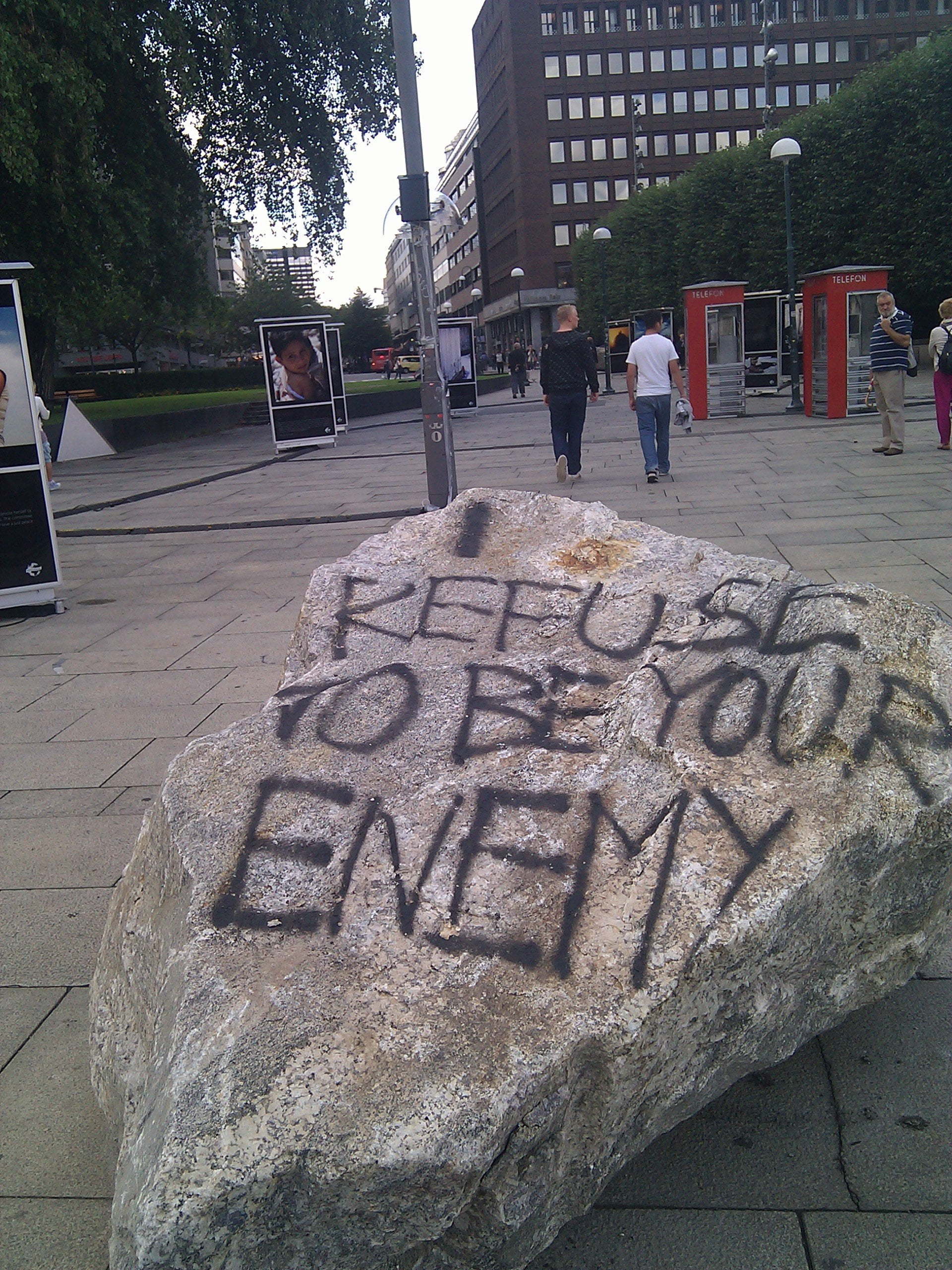
Except perhaps to say that I understand their fear of black nationalism, but only because I fear racial nationalism in all its forms. We are in the end only – and all – mere people, afraid that our futures might not meet our expectations. But any attempt to secure a prosperous and healthy future that begins with forcing others into silence is likely to fail, and to make us see enemies where they might not exist. There’s no shortage of real enemies, after all – and we find out who they are by talking to each other.