

I realise that most people are focusing on today’s election in the United States (the lizards will win, no matter what!), but I nevertheless wanted to make a few points about South Africa’s official opposition party, the Democratic Alliance (DA).
Category: Politics
Politics both in theory and in terms of party politics, mostly focused on South Africa.

Many, many years ago, I wrote something about how Barry Ronge was talking nonsense when he said that we can’t take Breyten Breytenbach calling South Africa a “kleptocracy” seriously when he (BB) doesn’t even live in South Africa.
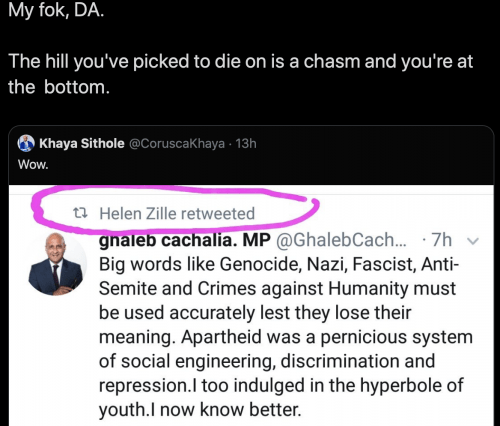
Today, Helen Zille is talking the same nonsense, in response to a Justice Malala column (probably paywalled) that includes this paragraph:

South Africa has been under lockdown for seven weeks now, in what seems to be one of the most restrictive Covid-19 lockdowns anywhere in the world. And while most people I talk to still support the lockdown in general, there seems to be increasing dissent regarding some of its regulations – even outside of the Twitter echo chamber of outrage.

Last week, I suggested on Twitter that Capetonians might want to comment on the City’s “management of public spaces” by-law amendments before the deadline of May 17, but didn’t say why, hoping that people would read the amendments and decide for themselves.
But in case it’s useful, here is a short summary of my concerns. You are free to copy and paste them into your responses if you choose, or to submit a version of them under your own name.
Sometimes a technical definition of something matters significantly less than the demonstrable effects it has had. If Harvey Weinstein is acquitted of the various rape charges he’s facing, that would have no implications for the women he has abused (if he is indeed guilty, as I believe he is).

One of the few positive recent developments for the Democratic Alliance is the fact that Mbali Ntuli will be contesting for leadership of the party at their elective conference in May this year.
I say this because, as a current ex-supporter of the party, I’ve long been trying to persuade friends that there are still liberals of the “right” sort in the party, but that they are mostly younger leaders who have not yet (for the most part) occupied the top positions in the party.
With critics like Ismail Lagardien about, it’s not so obvious that political parties need to spend time defending themselves, rather than simply pointing to negative opinion pieces about them while trying to resist guffawing. This is because while much of what Lagardien says contains a kernel of truth, this contribution is hyperbolic – and prolix – enough that it would only entrench existing biases rather than change any minds.
Steven Friedman is right to say that BLF should be allowed to compete as a political party, even though they limit membership to black voters only. He makes this case in his Business Day column of July 31 (paywalled), but you can also read it on his Facebook wall.
The South African Electoral Act says that parties may not discriminate on racial grounds, and while that means the BLF is legally in the wrong, it tells us nothing about whether the Act deals with this matter in an ideal way.

Early this morning, Quillette (a conservative-leaning online magazine, founded by Australian writer Claire Lehmann) editor and photojournalist Andy Ngo was the target of antifa (anti-fascist) protest while covering a rally in Portland, Oregon. The banner photograph is from when he was admitted to the emergency ward for treatment. He also had some of his photographic equipment stolen during the incident.
I don’t like many of the views that authors on Quillette espouse, even as I’m happy to concede that Quillette is on the whole more objective than some of their critics claim them to be. But the point of this post is that this doesn’t matter: you don’t need to agree or disagree with a writer or speaker to know that it’s wrong for them to be assaulted for holding the views that they do.

Along with many of you, today I made a difficult decision regarding which party to vote for in South Africa’s National elections – more difficult than any of the previous 10 (if you include the Municipal elections) were.
In one respect, I take that as a positive thing, because competition is good, and more than one option on the ballot today had merits to consider. It’s sometimes a sign of a more mature democracy that the choice of whom to vote for isn’t utterly obvious.