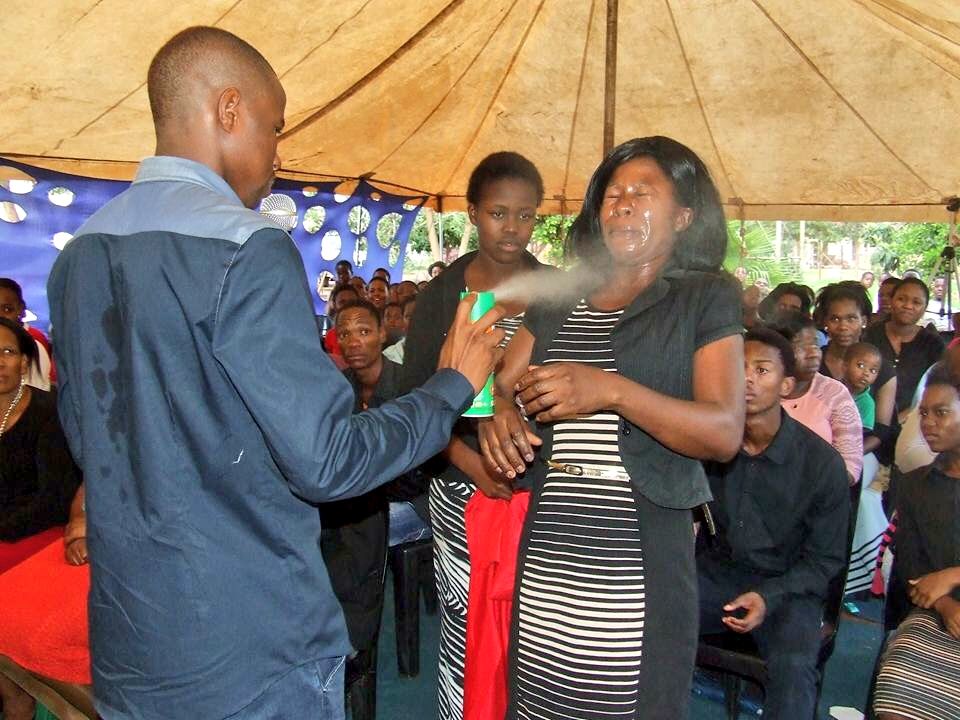
As reported in a previous post, Uganda is currently considering a bill that would impose the death penalty or life sentences on homosexuals. Furthermore, the proposed bill criminalises those who do not report a suspected gay person within 24 hours, and will most likely also have the effect of dissuading health care professionals in Uganda from assisting anyone who is gay – as well as dissuading gay people from seeking treatment, seeing as outing yourself as gay could land you in jail. It’s worth reading this story on NPR to see the extent to which American Evangelical Christians are prepared to foment hatred and prejudice in order to buttress their support bases in the 3rd World – after all, surely all those folk in Africa will one day be able to afford to buy their sermons on DVD? Continue reading »
Groucho Marx (borrowing from Freud, as Woody Allen reminded us in Annie Hall) famously said “I don’t want to belong to any club that will accept me as a member” – and while the point of the joke is most likely self-deprecation, it also reminds us that we sometimes need to be skeptical about the clubs we join – and the clubs we form.
Last night, Skeptics in the Pub (Cape Town) had their second meeting. I missed the first one while traveling, so was keen to meet up with the group and see what I’d missed out on in December. It turned out to be an interesting evening, although perhaps not for reasons any of the other attendees would appreciate hearing about, and made me wonder more than once whether it was the sort of gathering you could (perhaps should) go to once in your life, but never again – because each iteration of these gatherings feels just like the previous one. Every so often, a person, or a person and a few friends, decide that they should form some society or other, recruit people to their cause, and go out and change the world (or manageable little bits of it, at least). Continue reading »
A couple of nights ago, the Doctor and I watched a feature-length episode of Oprah directed by Clint Eastwood, titled Invictus. It was somewhat like going to a church service (at least as far as I can recall) where everyone is hopped-up on Ecstasy while trying to channel the spirit of the Dalai Lama – such was the overwhelming schmaltziness of this account of how Mandela saved South Africa with an oval ball. Parts of it were good – here in South Africa, much chattering occurs around the authenticity of accents when movies feature local characters, and both Morgan Freeman and Matt Damon did a good job in this regard. Also, some of the action scenes (rugby scrums and so forth) were appropriately animalistic (in general, though, the rugby scenes were rather devoid of tension or spectacle). But in what appears to be a concerted effort to win a couple of Oscars, Eastwood lays on the cheese to such an extent that at one point the Doctor remarked “this is more than cheesy – it’s an entire fondue!”. Continue reading »
Anthony Gottlieb tells us that Simon Blackburn ‘remarked that [Karen] Armstrong’s attitude to religion is reminiscent of Alice after hearing the nonsense poem “Jabberwocky”: “Somehow it seems to fill my head with ideas—only I don’t exactly know what they are.” Armstrong is far from alone among believers in retreating to the haven of incoherence.’ And as we draw near to Christmas, the incoherence takes on a peculiar character – infecting perhaps unbelievers and believers alike – as the vast majority of those living in some form of Christian society partake in ritualistic eating, drinking and general merriment. On one level, this is not incoherent for unbelievers at all, seeing as this sort of winter festival was a pagan tradition long before the Roman church appropriated all the pagan shrines and claimed the festival for itself, premised on historically questionable accounts of the birthdate of a historically questionable person.
But some unbelievers will find themselves at dinner tables with relatives and friends who do take these modern myths seriously, and who sometimes appear to believe that we can know exactly which ideas our heads should be filled with, and why. And they may play along, sitting politely while prayers are uttered, not protesting when these relatives and friends say crazy things. This could sometimes involve some incoherence, in that your unbelief isn’t standing in the way of allowing others to continue believing absurd things. The politics of these situations are complex, though, and I don’t mean to argue that one has an obligation to always burst the belief-bubbles of others.
After all, some of these religious ideas, as exemplified by Christmas, are noble and good: friendship, love, giving, and having fun come to mind, as does the simple idea of having a few days off work. But if one gets the sense that these ideas – or others not mentioned here – are somehow premised on a particular time of year, the fear grows that they may increasingly become reserved for that time of year. As with resolutions at New Year, or that month after a trip to the dentist, where one flosses obsessively before reverting to more typical patterns, our plans and intentions count for little if they affect our behaviour for a trivially short time, or affect our behaviour only when we are reminded to behave differently due to the promptings of events on the calendar.
This “holiday season” has so far been filled with the best and the worst of human character – as all months are. Last week, the Doctor and I were mugged. A friend disappointed us with his narcissism. Another friend has a partner whose tolerance for pseudoscience is leading her to not want to vaccinate their one year-old child, thereby endangering his life (and the lives of everyone else on the planet, in a small way). She also wants to send him to Sunday School, where she believes he will learn “history”. But the child is beautiful, and fascinating. Another friend has a daughter, and the interactions between her and her parents really make one hope that parenting has anything significant to do with the way children turn out. Likewise with some newer friends, whose two children are so well-adjusted that one can’t help but treat them as real people. And of course, the Doctor and I have much to be thankful for, and will no doubt continue to have a season filled with joy.
But it’s always this way – people do stupid things and clever things, they harm and they help, and they sometimes have no clue which they are doing, or why. And perhaps the balance shifts towards the positive over Christmas – I don’t know (and on the whole, it probably doesn’t, given all the lives traditionally lost on the roads at this time of year). It won’t, however, make much difference if people are especially nice to each other for such silly reasons. As us atheists often remark, a definition of “goodness” which is premised on being accountable to Big Daddy hardly makes one virtuous – and likewise, being charitable and generally “nice” to one’s fellow humans because it’s Christmas is not the motivation I’d hope for, seeing as I then have no guarantee you won’t be a complete tosser for the rest of the year.
While church attendance seems to be declining across (most of) the globe, and religious adherence generally falling (except for Islam, which is growing), we’re far from being out of the woods. Evangelical threats to liberty continue to haunt us, despite the fact that – judging from American Christians – most of the faithful are doing their utmost to undermine the faith, mostly by being moronic:
Only 40 percent of Americans can name more than four of the Ten Commandments, and a scant half can cite any of the four authors of the Gospels. Twelve percent believe Joan of Arc was Noah’s wife. This failure to recall the specifics of our Christian heritage may be further evidence of our nation’s educational decline, but it probably doesn’t matter all that much in spiritual or political terms. Here is a statistic that does matter: Three quarters of Americans believe the Bible teaches that “God helps those who help themselves.” That is, three out of four Americans believe that this uber-American idea, a notion at the core of our current individualist politics and culture, which was in fact uttered by Ben Franklin, actually appears in Holy Scripture. The thing is, not only is Franklin’s wisdom not biblical; it’s counter-biblical. Few ideas could be further from the gospel message, with its radical summons to love of neighbor. On this essential matter, most Americans—most American Christians—are simply wrong, as if 75 percent of American scientists believed that Newton proved gravity causes apples to fly up.
The problem is that once people lose the capacity to generate reasoned conclusions for themselves, and once their base of evidence from which they make their inferences is so detached from reality, the opportunity increases for charlatans to step forth, selling them various package holidays in the hereafter. And the more marginal a faith becomes, perhaps the more strident its adherents become through their fear of becoming redundant. So, whereas Christians used to be all about peace, love and forgiveness (at least according to my childhood memories), they increasingly seem to be about intolerance and hate (with increasingly rare exceptions).
Yesterday, The Guardian reported that Uganda looks likely to pass a law making homosexuality a capital offence, “joining 37 other countries in the continent where American evangelical Christian groups are increasingly spreading bigotry”. Now, of course it’s true that many Christians would not condone this. I would like to be able to say “most”, rather than “many”, but the two trends described above make “most” sound far too optimistic. If the gradual decline of religion is making the religious more strident, and if this is combined with an increasing trend of the religious no longer knowing what their religion is about, the extremists tend to set the agenda, and the more civilised believers sit on/wring their hands, despairing of what has become of the church.
We should not complacently think that this sort of thing is impossible in South Africa – we have the growing influence of the National Interfaith Leadership Council to worry about, along with more the regular cast of god-botherers such as Errol Naidoo, who has not shown himself to be averse to supporting prejudicial stereotypes with regard to homosexuality. It’s far too infrequent that we see the more tolerant sort of Christian protesting the manner in which people like Naidoo and Immelman express themselves on these topics, yet us atheists are frequently accused of caricaturing or misunderstanding religion.
How can we not caricature, when the only religious pronouncements that reach the public media sound like bad attempts at satire?


Recent comments