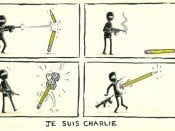
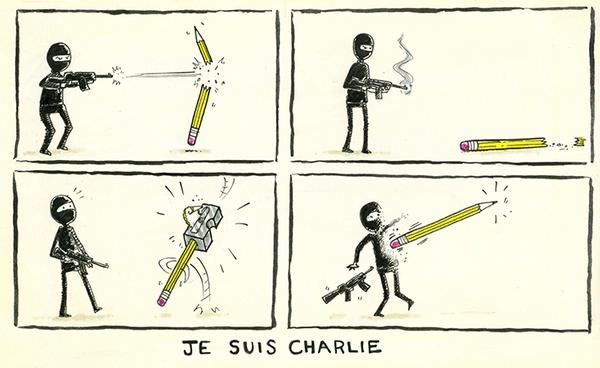
As much as being religious can interfere with peoples’ ability to think objectively about moral issues, it’s sometimes the case that antipathy to religion can do so, too.
The former problem arises because people can approach moral problems with unquestionable fundamental rules in mind, given to them by a divine force, and the latter because we should really only care about other people’s values when those values might result in harm, and not simply because we find them silly.
James Walmesley - https://twitter.com/RteeFufkin/status/552937192252006400
Yesterday, twelve people died for blasphemy.
Be clear about at least one thing: regardless of your views on religion, or on the role that Islam (or monotheism more generally) might play in generating intolerance and violence, nothing justifies murdering people for expressing offensive views.
Be clear on a second thing also: the fact that one is able and allowed to express offensive views is a necessary element of any society that wishes to be considered free, and we should all stand in support of the right to express such views.
James Walmesley – https://twitter.com/RteeFufkin/status/552937192252006400
I’ve said before that satire and blasphemy can be “a reminder to members of an identifiable social or religious group to get your house in order, so that there is no longer any need to mock or ridicule.” It serves a valuable role, and a role we should cherish. Joe Randazzo, previously editor of The Onion, is right to say that:
Satire must always accompany any free society. It is an absolute necessity. Even in the most repressive medieval kingdoms, they understood the need for the court jester, the one soul allowed to tell the truth through laughter. It is, in many ways, the most powerful form of free speech because it is aimed at those in power, or those whose ideas would spread hate. It is the canary in the coalmine, a cultural thermometer, and it always has to push, push, push the boundaries of society to see how much it’s grown.
Other issues are perhaps not as easy or unambiguous as we might prefer. For starters, the right to express a view doesn’t always mean it’s a good idea to do so. Take this Tweet from the President of American Atheists as an example:
He’s making a point, yes. I get that. He’s exercising his freedom to blaspheme, and he’s allowed to do so. But the blasphemy in that Tweet adopts a shotgun approach – it will offend all sorts of Muslims, from the ones who are inclined to kill people for blasphemy, all the way through to your next-door neighbour whose birthday party you might have attended a few days ago.
But as I’ve said many a time, these are strategic choices rather than issues of rights – he has the right, shouldhave the right, and we should all defend the right to be as obnoxious as you like, even as we might not like what you say.
A final point, before handing over to a press statement I sent out yesterday in the name of the Free Society Institute. My first Tweet on the murders was to say this:
If #CharlieHebdo attack ends up being motivated in part by religion, please remember that the perpetrators are brutes 1st, religious 2nd.
A predictable flurry of trolling resulted, with some even thinking that I was being an apologist for religious extremism. Apologies (not really) for complicating biases with these nuances, but my sentiment in no way denies that religion, and Islam, can play a causal role in generating violence such as this.
My point was that it’s a glib, and oftentimes lazy, inference to draw that it’s “religion” that causes these things. I would think it rare that religion per se makes you homicidal, but that instead, folk who are capable of such things will find religious inspiration for doing them.
If your religion allows you to be led to such barbarism, there’s barbarism in you to be exploited. That doesn’t mean that religion X (or ideology X) cannot be a causal factor in barbarism more often than religion or ideology Y.
To be clear: Islam should certainly bear some of the blame, in that if your religious texts or traditions are capable of inspiring people to do these barbaric things, they are in that respect toxic, and antithetical to liberty, flourishing and security.
The simple truth is that the gods could have been far clearer. Even if you’re religious, and want to assert that terrorists are misinterpreting the scriptures, you should be struck by the absurdity of your god not having chosen the simple path of saying: “hey there! While you’re having your arguments about what I want you to do and not do, remember that I don’t want you to kill, ever”.
Because she didn’t say that – or because she says things in a way that allows people to read her as saying the opposite, this is religion’s problem and religion’s fault, and people of faith can’t wash their hands of it.
And to a significant extent, they don’t. Which is why, as I said in the Tweet, the most important feature of yesterday’s killers is that they are killers, and not that they are Muslim.
The Free Society Institute stands with Charlie Hebdo and all defenders of free speech and civil liberty in condemning the murder of two police officers, three cartoonists, and eight journalists in Paris on January 7.
As offended as those of the Muslim faith might find blasphemy to be, that offence pales into insignificance compared to the brutality of Islamo-fascist terrorism such as this. Being offended does not grant one warrant for ending the lives of others.
The right to free speech does not, however, say anything about when it is wise to exercise that freedom or not.Neither does the fact that these terrorists were recorded as shouting “Allahu Akbar” and “We have avenged the prophet” during their attack tell us anything incontrovertible about Islam in general.
Tragedies such as these, that shock and confuse, can make easy answers attractive to us, in that they can lend themselves to stereotype and simplistic analysis. This is not the time for either of these.
Instead, this is the time for two simple things: to express our sympathy to all who are affected, and second, to recognise that we are all affected, in that freedom of speech is a cornerstone of civilised society, and is slightly more under threat to us all in the wake of the Charlie Hedbo attack.
Jacques Rousseau
Chairperson – Free Society Institute
The IHEU is today releasing a report on discrimination against non-religious people, with examples drawn from all over the world. It makes for interesting reading, because in addition to all the cases that get widespread media attention, the problem of discrimination against the non-religious is perhaps a larger one than many people realise. The report offers many examples of such discrimination, sometimes in the expected places, but also in jurisdictions where you’d hope for freedom from persecution on grounds of non-belief.
Freedom of Thought 2012 covers laws affecting freedom of conscience in 60 countries and lists numerous individual cases where atheists have been prosecuted for their beliefs in 2012. It reports on laws that deny atheists’ right to exist, curtail their freedom of belief and expression, revoke their right to citizenship, restrict their right to marry, obstruct their access to public education, prohibit them from holding public office, prevent them from working for the state, criminalize their criticism of religion, and execute them for leaving the religion of their parents.
The report highlights a sharp increase in arrests for “blasphemy” on social media this year. The previous three years saw just three such cases, but in 2012 more than a dozen people in ten countries have been prosecuted for “blasphemy” on Facebook or Twitter, including:
In Indonesia, Alexander Aan was jailed for two-and-a-half years for Facebook posts on atheism.
In Tunisia, two young atheists, Jabeur Mejri and Ghazi Beji, were sentenced to seven-and-a-half years in prison for Facebook postings that were judged blasphemous.
In Turkey, pianist and atheist Fazil Say faces jail for “blasphemous” tweets.
In Greece, Phillipos Loizos created a Facebook page that poked fun at Greeks’ belief in miracles and is now charged with insulting religion.
In Egypt, 17-year-old Gamal Abdou Massoud was sentenced to three years in jail, and Bishoy Kamel was imprisoned for six years, both for posting “blasphemous” cartoons on Facebook.
The founder of Egypt’s Facebook Atheists, Alber Saber, faces jail time (he will be sentenced on 12 December).
“When 21st century technology collides with medieval blasphemy laws, it seems to be atheists who are getting hurt, as more of them go to prison for sharing their personal beliefs via social media,” said Matt Cherry, the report’s editor. “Across the world the reactionary impulse to punish new ideas, or in some cases the merest expression of disbelief, recurs again and again. We even have a case in Tunisia of a journalist arrested for daring to criticize a proposed blasphemy law!”
The United Nations Special Rapporteur for Freedom of Religion or Belief, Professor Heiner Bielefeldt, welcomed the research. In a foreword to the report Bielefeldt notes that there is often “little awareness” that international human rights treaties mean freedom of conscience applies equally to “atheists, humanists and freethinkers and their convictions, practices and organizations. I am therefore delighted that for the first time the Humanist community has produced a global report on discrimination against atheists. I hope it will be given careful consideration by everyone concerned with freedom of religion or belief.”
Notes
An advance copy of the Freedom of Thought 2012 report is available from:
http://www.iheu.org/files/IHEU Freedom of Thought 2012.pdf
The International Humanist and Ethical Union (IHEU) is the world umbrella group bringing together more than 100 Humanist, atheist, rationalist, secularist, and freethought organizations from 40 countries.
That Sheffield-refugee 6000 has beaten me to the draw on this one (and also on Red Bull pulling their blasphemous ad) – both posts are worth a read. Errol Naidoo’s outraged newsletter regarding Woolworth’s latest offence against women, children, God, Naidoo, decency and family values hasn’t arrived yet, so we can’t be sure just how much offence Woolworths have caused, but it seems to be quite a lot. You see, they had the unfathomably insensitive idea of putting a Halaal certification on hot cross buns.
Yes, hot cross buns – those delicacies eaten over Easter, a religious festival that some Christians refuse to celebrate because of its pagan origins. But no matter how offensive it might be to have the obvious pointed out to you (and it often is), these buns have always been halaal. And kosher. And the relevant stamps have been on the packaging for years now. From next year, you’ll be able to buy the buns without the relevant stamps, but they will be the same buns as before – still kosher, still halaal. But the hypersensitive Christians among us will at least then be able to go back to burying their heads in the sand, and forget about this full-scale assault on all they hold dear.
But since when have hot cross buns been considered a religious food, in any case? For quite a while, at least according to Wikipedia, which tells us that they were “eaten by Saxons in honour of the goddess Eostre”. We should certainly boycott those blasphemous Saxons, then. And how is this worthy of a boycott threat to Woolworths in any case (not to mention a front-page story in The Mercury), when all Woolworths are doing is reminding a significant proportion of their client-base that these buns won’t result in whatever damnation the eating of something without a halaal stamp is supposed to cause?
There are more serious things to worry about. Not only genuinely outrageous things, like the occasional evils committed in the name of religion (like the girl who recently died during an attempted exorcism) , but also (less serious, of course) things like consistency. These buns are sold year-round, and again, have been for years (with the halaal stamp). If hot cross buns have special significance to Christians, I’d imagine that significance to be strongly linked to Easter. So, if you want an extra thing to hyperventilate about, dear Christians, consider boycotting Woolworths until they also agree to only sell hot cross buns between certain dates, specified by you (or God, if you can get her on the line).
The fact that Woolworths have capitulated to this hypersensitivity is absurd. The complainants should simply have been told to grow up and remember that they live in a multicultural society, where they can’t demand special respect for grievances such as these. Judging by the jokes and mockery from other Christians on Woolworth’s Facebook page and on Twitter, this threatened boycott would probably have resulted in approximately a dozen fewer hot cross buns being sold, and surely that’s a worthwhile price for Woolworths to pay to avoid lowering the bar on what counts as significant offence even further?
On a related (albeit tangential) note, consider this billboard I spotted in Camps Bay recently:
We probably won’t see any claims of copyright infringement emerging from Tiger Brands, because of the default respect that is afforded to religion. Perhaps if the Laugh it Off folk had used this logo on a t-shirt there would be some complaint from the copyright holders, but here it would no doubt simply be considered a light-hearted and excusable appropriation of their logo. They wouldn’t mind this usage, in other words, because the association with this church is by default a positive association. Well, seeing as I’m an anti-natalist as well as an atheist, I’ll henceforth boycott All Gold until they sue that damn church. Perhaps.
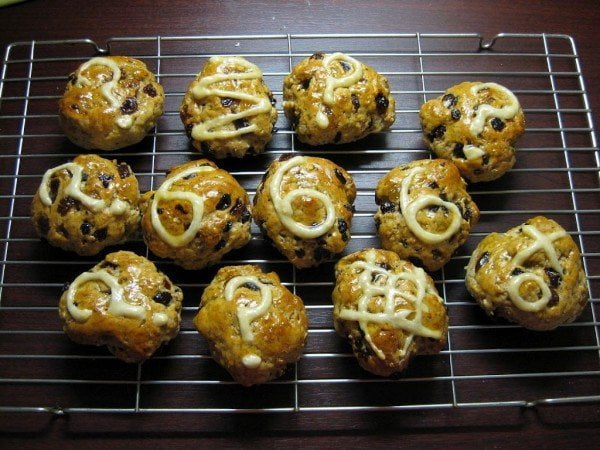
Of course I won’t, partly because I don’t care, and because I might have done the same thing if I were involved in the billboard’s planning, and the same (no-) thing if representing Tiger Brands. It’s not worth a fuss, and can only be considered offensive from a position of deep insecurity (and of course, the same sort of response can be found among atheists also). And if Christians want to boycott Woolworths over this, all they will achieve is diminishing their own credibility, as 6000 points out in the link above. As for me, this Easter I’ll hopefully be able to enjoy some hot question buns, as in previous years, thanks to my blasphemous wife:
While lacking the high-profile support and marketing opportunities that Primedia and others lent to the Bill of Responsibilities, there’s another document doing the rounds that is even more wrong-headed – if such a thing is at all possible. It’s called the “South African Charter of Religious Rights and Freedoms”, and according to one of its drafters, Rassie Malherbe, is intended to “flesh out the right to freedom of religion in the Constitution”.
This fleshing-out is apparently required due to the fact that “constitutional rights are described in cryptic, vague and general terms” (pdf). Sections 9, 15, 31, 185 and 186 seem fairly clear to me, and when read in conjunction with sections 10 and 12 of the Promotion of Equality and Prevention of Unfair Discrimination Act, it’s quite difficult to understand how religious belief could be better protected.
Of course, I’m assuming that religious beliefs should be treated as merely one form of belief competing with others on the ostensibly level playing-field provided by an impartial state. As matters stand, I’m already a candidate for appearing before the Equality Court for communicating words “that could reasonably be construed to demonstrate a clear intention to be hurtful” when speaking of religion.
Churches already enjoy preferential treatment from the taxman, while non-theistic organisations do not. The religious voice carries a disproportionate weight in debates around whether TopTV can screen pornography. On a more trivial note, for those who suffer from unpredictable thirsts for alcohol or who struggle to plan ahead, moral standards set by religion dictate the terms of liquor licences. One could go on, but the upshot of these facts is that many claims for religion requiring more protection are tenuous at best.
More worryingly, these sorts of charters have a history of allowing for discrimination against the non-religious, rather than simply proving equal protection for all. The UN resolutions on “Combating Defamation of Religions” that have made regular (and sometimes successful) appearances before various UN commissions and councils bear notable similarity to blasphemy laws such as those enforced in Ireland.
Under such laws it’s not only the case that you can (somehow) defame an idea or ideology rather than a person, but you can also go to jail for doing so. Presumably, the South African Charter would hope for such a future also. One of its clauses (6.4) states: “Every person has the right to religious dignity, which includes not to be victimised, ridiculed or slandered on the ground of their faith, religion, convictions or religious activities. No person may advocate hatred that is based on religion, and that constitutes incitement to violence or to cause physical harm.”
While the second sentence of the clause quoted above might be controversial for some, it’s nevertheless already entrenched in the Bill of Rights and Equality Act. So the Charter adds no protection by repeating it, assuming the Charter becomes law as intended by its drafters. But to demand protection from victimisation or ridicule is surely a step too far, especially when read in conjunction with something like 2.2: “Every person has the right to have their convictions reasonably accommodated”.
If reasonable accommodation comes to mean immunity from criticism – which it certainly could, with a broad notion like “victimisation” being very much an eye-of-the-beholder sort of thing – it would only be the religious that truly enjoy the rights to freedom of thought and expression afforded to us in the Bill of Rights. Those who want to express negative sentiment with regard to religion (and other categories like culture, which are also included) are of course not victimised as a result of having these protections withheld.
It goes further, as these things often tend to. On the grounds of religious belief, you can refuse to deliver “certain services, including medical or related (including pharmaceutical) services or procedures” (2.3b). And “no person may be subjected to any form of force or indoctrination that may destroy, change or compromise their religion, beliefs or worldview” (2.5) – but the same would of course not apply to that kid in the classroom who has doubts that women were magicked into existence from the rib of a man.
Furthermore, the state, including the judiciary, must “respect the authority of every religious institution over its own affairs” (9.3), and parents “may withdraw their children from school activities or programs inconsistent with their religious or philosophical convictions” (7.1). For a document that’s drafted partly in response to constitutional rights that are allegedly “cryptic, vague and general”, you’d hope for some more specificity in this charter. There is little to none of that, and I’ve only highlighted six of the thirteen clauses that are obviously problematic.
At the launch of this charter in October 2010, Deputy Chief Justice Dikgang Moseneke stopped short of endorsing it, saying that it might one day be a matter before the Constitutional Court. He nevertheless welcomed the initiative, and it seems likely that our new Chief Justice would be similarly inclined. As yet, though, there’s been little progress, and the charter has yet to be presented to even a parliamentary committee. But there are signs of life – a January article in Beeld spoke of it in positive terms, and callers to Radio Sonder Grense later that month seemed particularly enthused.
Perhaps most troubling, last week the Commonwealth Advisory Bureau issued an invitation for applications to write a paper on the right to religious freedom and belief in Commonwealth countries, in order to inform the proposed Commonwealth Charter. In this invitation, the South African charter is highlighted as an example of best practice. So even if it never reaches our parliament, there’s now a chance that other parts of the world will have the sensibilities of Malherbe and others imposed on them.
There’s no question that we need to tolerate diverse and dissenting views, and I’m sympathetic to the reality of many religious people feeling persecuted or victimised for their beliefs. Some instances of such victimisation are clearly unjust and immoral – but they are also usually already illegal and not meriting further legislation. This is part of the point of a broadly secular set of laws: that once we start creating special protections for one interest group, we have no principle by which to refuse doing so for all others.
Instead, ideas compete on their merits within a framework that attempts to give everyone an equal chance to air their views. Charters like this one hark back to a world in which a default privilege was afforded to the dominant view, and where that dominant view was a religious one. While that view is still dominant in this country as in many others, that dominance results at least in part from peoples choices and their freedom to make those choices. Let’s not entertain the nonsense that this freedom is threatened to such an extent that it can – or needs to – be protected through granting one view the sorts of protections all others lack.
If Zehir Omar is reporting court proceedings accurately, then I and the other participants in a secular conference we attended this past Saturday should be arrested. We didn’t burn anything, but we certainly said and discussed things that would be guaranteed to cause offense to a significant number of Christians, Muslims and followers of other faiths.
Omar is an attorney who represents Scholars of the Truth, a Gauteng-based Muslim organisation. On Saturday, he successfully sought an interdict against the planned burning of a Bible by Mohammed Vawda. Vawda claims that his plans were motivated by his anger towards the similar intention of Terry Jones to burn a copy of the Quran on September 11.
According to Omar, the court “accepted [his] submission that freedom of expression is limited if the exercise of one’s freedom of expression will evoke offence in members of our community”. It’s worth noticing that this is quite a curious argument for Omar to have made, seeing as it is rather self-incriminating. He is, after all, the same person who demonstrated little interest in tolerance last year when he argued against the appointment of Justice Kathy Satchwell as a Constitutional Court. “God-fearing people”, he said, would find her lesbianism unacceptable.
The original text of this column, first published in Daily Maverick.
We all find something offensive. Many of us might prefer to live in a world which caters to our sensibilities, and limits how much offence we have to tolerate. I would like for everybody to be able to spell, for example, and also for most uses of quotation marks in advertising to be outlawed. Unfortunately, nobody seems willing to offer me any legal assistance towards achieving these outcomes.
Jonathan Shapiro (a.k.a. Zapiro) is an equal opportunity offender – that is, if you like to think of what he does as offensive at all. There’s no doubt that some people have been, and are, offended by some of his cartoons, but that is a separate matter from whether they are in fact offensive, objectively speaking.
His role as a social critic and commentator leads him to sometimes poke at open wounds, yes, but almost always in a way that reveals the underlying prejudices that cause significantly more harm than any harms caused by the cartoons themselves.
The cartoons challenge their audience to reflect on whether their feelings of outrage are justified, and also whether others – like Zapiro – may be justified in feeling that there is something worth critiquing, challenging, and even sometimes mocking, in opinions and beliefs that we sometimes take far too seriously.
Targets of his satire are drawn from a pool which has historically admitted just about anyone, and anything. If he has an axe to grind, that axe is most likely composed of inflated egos, undeserved reputations, malfeasance against the equal treatment and dignity of all – no matter how rich or poor, influential or invisible.
We should remember that critics of this sort, who offer a courageous perspective on current events, and try to point out details that we might be missing, serve an enormous public good. It’s very easy for all of us to end up with our heads buried in the sand, or stuck up our own (or another’s) backsides to the extent that we forget that our outrage may be ill-construed or illegitimate.
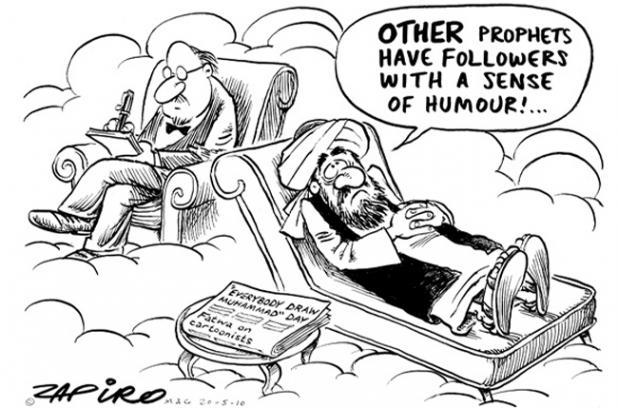
Today, Zapiro’s cartoon for the Mail & Guardian was the subject of a last-minute attempt to stifle press freedom. The Twitter feed of the unfolding events makes for interesting reading, in that Molana Bam’s primary argument appears to be the standard one where representations of Muhammad are concerned – namely, threats of violence.
Not directly, but nevertheless, the cartoon is a “threat to harmony”, and “stirs emotion”. A much larger threat to harmony, perhaps, is the struggle involved in reconciling Bronze Age beliefs with the modern world, and the curious tolerance that it requires those of us who try to govern our lives according to knowables. Tolerance, that is, of beliefs that are shared by fanatics who try to kill cartoonists and authors who represent aspects of that belief.
If you are a believer who is not inclined to fanatical – and criminal – action, you certainly should feel aggrieved when cartoons like this are published. But the cause of your aggrievement should be your less civilised brothers and sisters, who make such comment necessary – not those who make the comments.
The points made by Zapiro, as well as by past examples of this same issue, are a reminder to you to get your house in order, so that there is no longer any need to mock or ridicule.
You do this most effectively from the inside, by persuading people who take faith as a way to justify paedophilia, homophobia, oppression, murder, censorship and all sorts of other social ills that they have lost their way, and that surely a god worth taking seriously would not want you to do those things.
Two responses to the issue worth reading: Nic Dawes, Mail & Guardian Editor; Jordan Pickering (a Christian response).
Following the controversy caused by last year’s edition of Sax Appeal (see here and here, if you don’t know about this), the editor asked if I’d be willing to contribute a column. I was, and here it is, for those of you not in Cape Town (or those who simply ignored the pleas of those desperate students at the traffic lights).*
As of January 1 2010, blasphemy is a crime in Ireland, with offenders liable for a €25000 fine. Later in January, Kurt Westergaard – one of those responsible for the infamous “Danish cartoons” – was attacked in his home by a knife-wielding fanatic. Closer to home, some readers of Sax Appeal may still harbour memories of the outrage provoked by the “blasphemous” content of Sax Appeal 2009, and some others (well, the same ones, probably) may currently be choking on their morning tea while trying to process the harms they believe themselves to be enduring as a result of the edition you are currently reading.
So, the Frontline Fellowship (of which Peter Hammond is Director) has posted a description of the debate that was meant to happen recently. Here’s how it starts:
Atheist Abandons Argument
Just two hours before the scheduled debate the Atheist Association lecturer, Jacques Rousseau, cancelled his involvement and withdrew from the debate. The organiser was then compelled to change the venue from Jameson Hall to a different venue nearby.
Apparently, the event ended like so:
Over 100 students responded to the challenge to commit themselves to full-time Christian ministry. Many of those expressed their conviction that they were called to be missionaries to university campuses. The atmosphere at Campus Harvest was electric.
These 100 students will no doubt undergo rigorous training in hyperbole, hysteria and deception, judging from the article. All I can do is to – again – point out that if these students are at all interested in an education, and the facts, they can avail themselves of the evidence in the form of the correspondence leading up to the debate here.